
HOW TO STAY CALM UNDER PRESSURE (LIKE ELITE ATHLETES)
At Degree, we know that feeling confident under pressure starts with preparation: the right mindset, a solid routine, and knowing your body is taken care of. We partnered with Chibs Okereke (MSc Organizational Psychology) to share practical tools for managing nerves, stress sweat, and performance anxiety.
Chibs is a stress and burnout coach, mindfulness expert, and former CEO. A qualified Mindfulness-Based Stress Reduction (MBSR) facilitator, certified clinical hypnotherapist, and meditation instructor on the Calm app, he blends neuroscience-backed strategies with his own experience of burnout to deliver practical tools for resilience. His YouTube channels draw around 3 million views a month, and he has delivered keynotes for leadership teams at Fortune 100 companies worldwide.
Read on as Chibs shares practical tools to help you stay calm, focused, and in control when it counts.
Watch a sprinter in the seconds before a final, or a goalkeeper waiting for a penalty, and it's tempting to think they've switched the nerves off. They haven't. Their heart is going, their palms are sweaty, just like yours before a big meeting or presentation.
What they've trained isn't the absence of pressure. It's what to do with it.
I learned this the slow way. The first time I stood up to teach, in my local yoga studio, to a room of about 10 people, I was terrified. Scared I was being judged, certain I looked stupid. The whole time, my body and my head were telling me I was doing a terrible job, that I had no business giving anyone advice, that nobody was interested. But every time, afterwards, the opposite turned out to be true.
Somewhere along the way, the nerves stopped landing as fear and started landing as excitement. Same racing heart, same sweaty armpits. I just read it differently now.
So if you get hit by anxiety sweating before a big moment, you're not broken. You're human, and your body is doing exactly what it evolved to do.
I'll use "giving a presentation" as the example, but substitute whatever puts you under pressure: the interview, the first date, the start of a race.

HOW TO CONTROL NERVES BEFORE A PRESENTATION OR HIGH-PRESSURE MOMENT
Under pressure, your body reads the moment as a threat and gets you ready to act. Adrenaline rises, your heart speeds up, your breathing gets shallow and quick, and blood moves to your larger muscles.
None of this is a malfunction. It's the same biological system that once helped us run from danger, now firing up because you have to speak in front of a room.
The interesting part is that your body raises its hand before your mind catches up. My own signals are fairly predictable: shoulders creeping up towards my ears, jaw clenching, breath getting quicker and more in my chest.
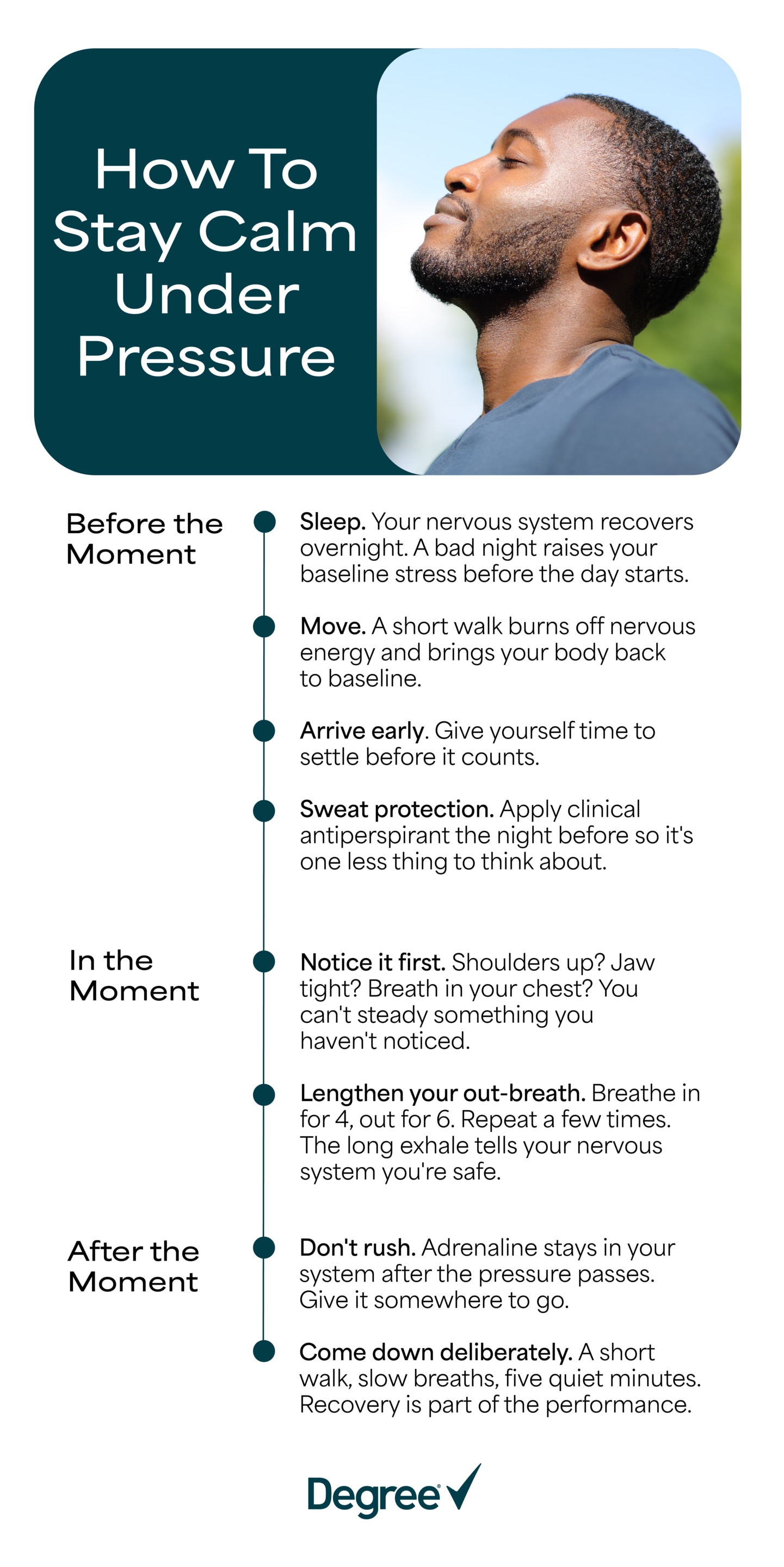
Learning to notice the signs early is the whole skill, because you can't steady something you haven't noticed.
Staying calm under pressure isn't one heroic act of will. It's down to three smaller things to help you overcome performance anxiety.
1. Preparation
I don't just mean knowing your material. I mean setting your body up beforehand: a decent night's sleep, some movement to burn off nervous energy, arriving early enough that you're not rushing in flustered. The more comfortable and prepared you feel in your body, right down to not having to think about whether you're sweating, the less your system has to manage when it counts.
2. A way back into your body
The fastest way I know is through breathing techniques for anxiety. When we're nervous, our exhales get shorter, which keeps the physiological alarm bells ringing. The trick is to lengthen the out-breath: breathe in for four, out for six. Do this a few times.
The long out-breath tells your nervous system you're safe. It's quiet, nobody can see you doing it, and you can run it in the 30 seconds before you walk in. If you want one tool for breathing exercises for stress sweat before a presentation, that's the one.
3. Recovery
After the pressure passes, the adrenaline is still in your system. Rather than white-knuckling straight into the next thing, give yourself a moment to come down: a short walk, a few slow breaths, a cup of tea while you look out the window. Treating the come-down as part of the job, not a weakness, is how you stay steady across a whole day rather than crashing at the end of it.
BEING CALM IS A PRACTICE, NOT A PERSONALITY
The people who look unflappable aren't a different species. They've just felt it and worked with it enough times that it's stopped running the show.
You can build the same steadiness. Not by feeling less, but by noticing sooner and knowing what to do next.
So the next time the pressure is on, see if you can catch it early. Where do you feel it first, before you've even called it stress? Start there. That noticing is where calm actually begins.
BE PREPARED: WHICH PRODUCT WORKS BEST IF YOU SWEAT MORE THAN AVERAGE?
The foundation of staying calm under pressure includes knowing your body is taken care of. If regular antiperspirant isn't up to the job on high-stakes days, a clinical-strength formula is worth trying.
Degree Clinical Protection Antiperspirant is formulated for people who need sweat and odor defense when it matters most. With up to 96-hour protection and MotionSense® technology that responds as you move, it’ll help you feel prepared for anything.
For persistent or excessive sweating that's affecting your daily life, it's worth speaking with a doctor.