

HOW TO FIND A DEODORANT THAT NEUTRALIZES ODOR (INSTEAD OF JUST MASKING IT)
You applied deodorant for body odor this morning. You felt good about it. By lunch, something went wrong. Not because you skipped a step or need a stronger product, but because most traditional deodorants were never designed to stop odor. They were designed to cover it. They layer scent over odor rather than neutralizing it, and this combination can smell worse than the sweat did on its own.
The best deodorant for body odor uses ingredients that target smell at the source. Here’s why masking fails, how odor-neutralizing technology works, and what to check for on the label.
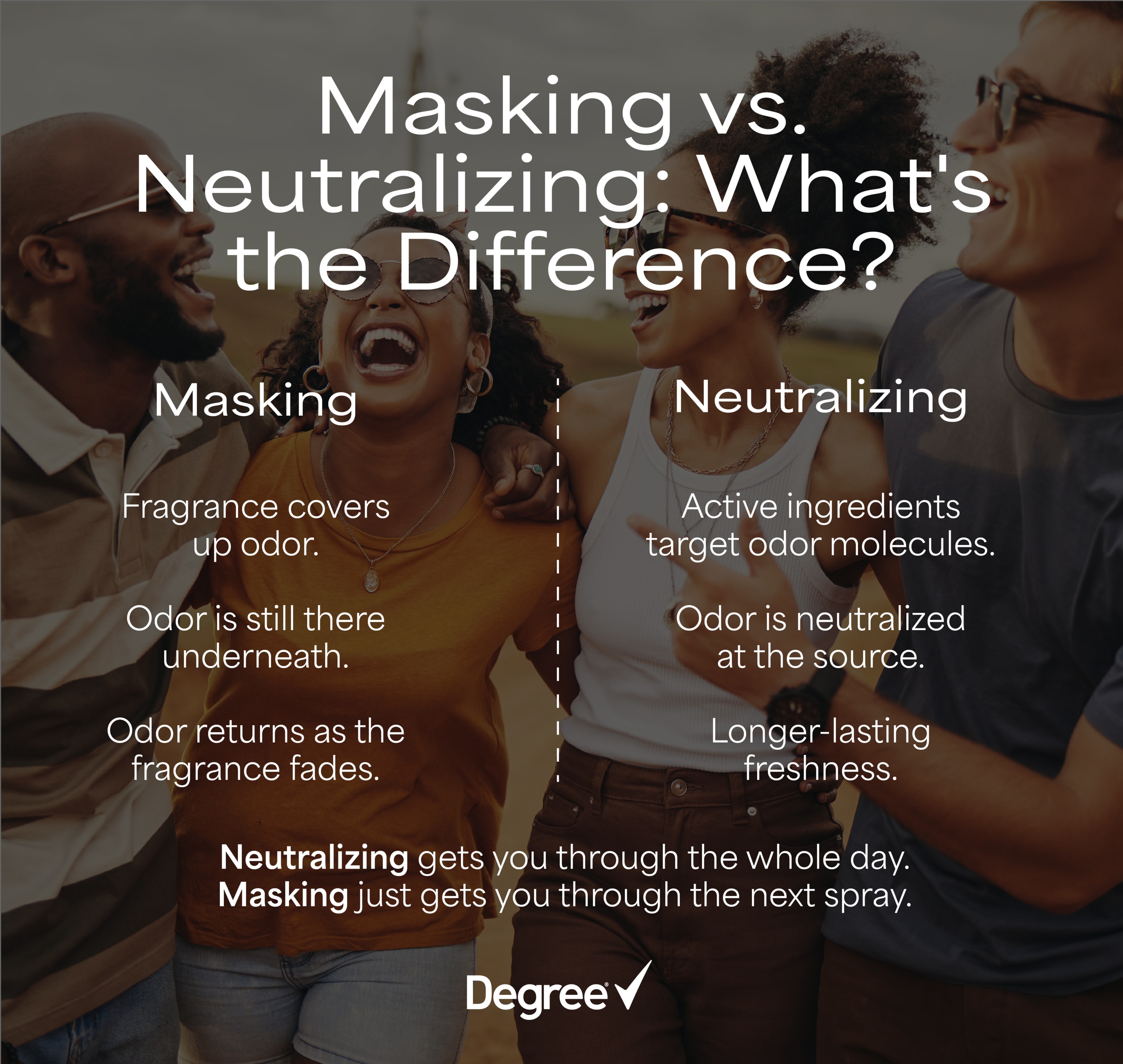
THE SCIENCE OF BODY ODOR AND WHY MASKING DOESN'T HELP
Think of your underarms as a chemistry lab that never closes. The moment you start to warm up, bacteria get to work breaking down compounds in your sweat. And that breakdown is what produces odor; sweat is mostly innocent.
Fragrance doesn't stop this process; it just sits on top of it. Unilever R&D Manager David Waters explains: “Ingredients that mask odor add fragrance that temporarily covers up smells, without changing the odor molecules themselves. Ingredients that actively neutralize odor chemically bind to, trap, or alter those molecules so they no longer smell, addressing odor at its source.”
Warm, sweaty skin speeds things up too. Fragrance fades fast in that environment while bacteria keep working on your sweat, one of the most common reasons your deodorant isn't working by mid-afternoon.
HOW NEUTRALIZING INGREDIENTS WORK
Zinc-based ingredients bind directly to odor molecules and break them down. Some formulas also include ingredients that reduce bacteria on the skin surface. Deodorant that kills bacteria isn't a permanent fix, but reducing bacteria on the skin means less odor gets produced in the first place.
Modern deodorants take this further with encapsulation technology. Tiny microcapsules sit on the skin and release active ingredients gradually as you move. Instead of one burst of fragrance in the morning that fades by lunch, you get continuous odor-fighting through the day.
Antiperspirant deodorants add another layer. By reducing sweat, they cut the bacterial fuel supply at the source, which means less odor-causing activity overall.
WHAT THIS LOOKS LIKE IN A REAL FORMULA
Degree's antiperspirant deodorants are a good real-world example of how these technologies work together. MotionSense® is Degree's version of encapsulation technology, releasing freshness gradually as you move rather than front-loading all the protection in the morning. Paired with aluminum-based actives that reduce sweat at the source, the result is a formula that tackles odor from multiple angles at once.
The right formula depends on what you're dealing with day to day:
For everyday odor and sweat control (women)
Degree Advanced Sheer Powder Antiperspirant Deodorant Stick offers 72-hour sweat and odor protection and MotionSense® technology combined with a scent of freesia, jasmine and vanilla.
For heavy sweating (men):
Degree Sport Strength Clinical Antiperspirant Deodorant Soft Solid offers prescription-strength wetness and odor control, 96 hours of protection and MotionSense® technology in a stick format. Ideal for active days or if you tend to sweat more than others, it has a scent that’s clean and masculine.
For clothing protection (men):
Degree 3in1 Antiperspirant Deodorant Stick+ Stain Protection combines 72-hour sweat and odor protection with a formula that prevents white marks and yellow stains. It also has MotionSense® technology built in and a long-lasting deep cedarwood and mellow fruit fragrance.
For aluminum-free, odor-neutralizing across more of your body (men & women):
The Degree Whole Body Deodorant range uses zinc-based ingredients for up to 72 hours of odor protection without antiperspirant actives.
WHAT TO LOOK FOR IN AN ODOR-NEUTRALIZING DEODORANT
- Ingredients that target bacteria, not just fragrance: Look for zinc-based ingredients on the label.
- Longer protection windows: 72- and 96-hour formulas tend to use stronger odor-fighting ingredients than 24-hour ones.
- A reasonable scent, not an overpowering one. If it smells strongly of fragrance in the store, it's probably leaning towards masking, not neutralizing.
- Choose an antiperspirant deodorant if sweat is part of the problem. Less sweat reaching the skin means less for bacteria to work with, which means less odor.
FAQs
Two signs: fragrance is strong at first but fades to a mix of fragrance and body odor by midday, or it works for a few hours and then stops completely instead of fading gradually.
There's no real overnight fix. Garlic leaves your body through sweat for a day or two after you eat it. The best approach is to shower with a scented body wash, apply deodorant to fully dry skin, drink extra water, and hold off on more garlic until it clears.
Yes. Leafy greens and other chlorophyll-rich foods can help from the inside. Cutting back on red meat, garlic, and onions helps too, and drinking enough water keeps sweat more diluted.
It sometimes can. Odor especially tends to build up in synthetic fabrics over repeated wears, and once embedded, the smell can return the moment you sweat, even in a freshly washed item. Wash workout gear within 24 hours, in cold water, and add a splash of white vinegar to the fabric softener compartment instead of regular softener.
No. A heavier fragrance can actually make things worse once it mixes with the odor underneath. The best deodorants pair neutralizing ingredients with a moderate scent, not fragrance alone.
Your deodorant might be relying on fragrance instead of neutralizing ingredients, you applied it to damp skin, or bacterial buildup from the day before hasn't been washed off yet. A zinc-based formula or an antiperspirant deodorant can make a real difference.
Most deodorants are built around fragrance, and they stop working the moment the scent fades and bacteria catch up. The difference an odor-neutralizing formula makes isn't subtle. When the right ingredients are doing the work, you stop thinking about how you smell by mid-afternoon. Because freshness is locked in.
;Resize=(200,200))
;Resize=(200,200))